
Experiential design is a formal profession that focuses on creating immersive environments to transform physical spaces. This discipline has been around for a long time. Its roots come from fields that have shaped physical environments for decades, including architecture, industrial design, graphic design, exhibition design, interaction design, psychology, and human-centred design. As these fields developed in our modern era, designers began paying closer attention to the overall experience of a physical space and to the role people played within it. This is when the discipline started to take formal shape.
A major milestone came in 1993, when cognitive scientist Don Norman joined Apple and his group began using the term “user experience” to describe the complete experience someone has when using a product or a service.
During the late 1990s and early 2000s, these UX ideas expanded beyond digital interfaces into broader experience design, where designers began considering environments, interactions, storytelling, and emotions as parts of one complete audience journey. Since then, experiential design has expanded into areas such as retail stores, museums, exhibitions, theme parks, ticketed attractions, festivals, seasonal experiences, hospitality spaces, experiential marketing campaigns, corporate events, brand activation, and other live events.
In this article, we will define experiential design, explain how it is applied in physical environments, and look at real examples that show how experiential design can transform a space into an immersive experience.
Experiential Design: The definition.
Experiential design, at its core, is the intentional creation of spatial, multisensory, and interactive environments that shape how people experience a physical space. It brings together different design disciplines to consider how people move through a physical space, what they encounter, how they interact with the experience, and how the space responds to them.
Experiential design shares some human-centred principles with user experience design (UX), although the two disciplines operate in different contexts. UX commonly focuses on people’s interactions with products, services, and digital interfaces, while experiential design focuses heavily on physical environments and the relationship between people, place, content, media, and interaction.
Applied to physical environments, experiential design considers what people see, hear, touch, explore, and do throughout an experience. It also considers the full audience journey, which is how the space changes around them, how information is introduced, where they move next, and how their own actions influence what happens around them.
To illustrate this definition, imagine a museum exhibition on space exploration. The experience begins when visitors enter a dark room, surrounded by stars and distant radio transmissions. The experience continues through a room featuring interactive planetary projections, moves into a simulated spacecraft, and concludes in a large projection environment that places visitors on the surface of Mars.
As you can see in this example, the exhibition immerses its visitors in space exploration, allowing them to experience what it would feel like to be in outer space. Additionally, each touchpoint introduced new information and sensory elements, creating one connected experience through storytelling, immersive technology, soundscapes, and interior design.
Experiential design, therefore, operates across several creative disciplines simultaneously. The designer looks at the environment as a complete system and determines how space, story, visuals, light, sound, interaction, physical objects, and technology will operate together to create an immersive experience for the audience. The goal is to create a cohesive, human-centred journey throughout the physical space.

Stargazer – Experience Design for Museum Exhibit, Space Exploration
How Is Experiential Design Applied to Live Events?
Experiential design is applied to live events by shaping an ordinary space with audiovisual technology, props, interior design, furniture, sound, and other elements to give people a reason to explore it. Depending on the event, the physical space may tell a story, communicate a brand identity, teach visitors something, entertain them, introduce a product, or transport them into a fictional world.
This discipline also considers the entire audience journey and its touchpoints, from the moment guests enter a space to their final interaction before leaving. These decisions influence how the physical environment is designed to support the event’s purpose and guide how people move, engage, and respond throughout the experience.
For example, consider a Christmas attraction built inside a convention centre. One room could recreate a snowy village using scenic structures, artificial snow, lighting, sound, and projection. Visitors might then enter Santa’s workshop, where interactive touchscreens let children complete activities before moving into another environment for a final meeting with Santa.
In contrast, a Halloween experience could follow a completely different creative direction. Narrow corridors, darkness, directional sound, physical sets, actors, fog, programmed lighting, and unexpected visual effects control what guests encounter as they move through the attraction.
To sum up, a retail environment may use many of the same principles for a different purpose. Product displays, architecture, digital screens, interactive installations, sound, lighting, and branded content can turn shopping into an immersive experience for consumers.
As we observe, the type of experience varies depending on the live event or physical space. Still, the central principle remains consistent: human-centred experiences in which the space is deliberately designed around the experiences people will have inside it.

Experience Syncra – Projection Mapping to Create Experience Design for Physical Space
Key elements of Experience Design.
Now that we have defined experiential design, it is important to analyze the key elements designers consider when creating human-centred environments and how these elements contribute to audience immersion.
Storytelling:
Storytelling plays an important role in many experiential design projects because it gives the environment a reason to change as people move through it. Humans love stories, and by experiencing a journey with storytelling, visitors will show multiple emotions that will keep them engaged in the experience.
The story can be presented in many forms, and it doesn’t need to follow a traditional format with characters or a traditional beginning and ending. For example, a museum exhibition about ocean conservation may move visitors from the beauty of marine ecosystems to the challenges affecting them, and conclude with actions people can take to preserve the oceans. A product launch may introduce a problem, reveal the engineering behind the solution, and eventually present the new product.
Ticketed attractions can develop this idea much further. Guests may enter a fictional environment, physically move through different rooms, and explore the story at their own pace. In this example, each room may introduce new information, characters, challenges, or visual environments while keeping the participant inside the same narrative.

DIYA Fest – Diwali Immersive Experience
Multisensory Design
People experience physical environments through several senses at the same time. Experience design considers how those sensory inputs work together.
Visual design usually carries a large part of the environment through scenery, lighting, projection, screens, colour, graphics, and architecture. Sound adds another layer through music, environmental audio, narration, sound effects, or directional speakers that place specific sounds within different areas.
Physical materials contribute texture and scale. A visitor walking into a winter environment may encounter artificial snow, cold-toned lighting, projected snowfall, wind sounds, and physical scenic elements that resemble ice or timber. Each layer reinforces the same setting.
Some experiences also incorporate scent, temperature, vibration, air movement, or physical effects.

Mirage – Projection to Create an Immersive Experience at a Shopping Mall
Interaction
While interaction is not required in every experiential design project, responsive environments give visitors an opportunity to participate directly in the experience. Interactive technology such as sensors, cameras, buttons, motion trackers, and other systems can modify how a physical space looks, sounds, or is lit according to the actions of the people inside it.
For example, in a museum, someone could move their hand across a digital table to explore an archaeological object. At a product activation, visitors might rotate a physical control and see a large 3D product visualization respond on an LED wall. Inside a ticketed attraction, guests could perform a gesture that triggers a spell or opens the next part of the story.

Experience Syncra – Cyberpunk City Immersive Experience
Technology
Immersive technology includes projectors, LED screens, lighting systems, spatial audio, interactive triggers, tracking systems, and other tools that can make physical environments dynamic and responsive. They are key in experiential design to create physical spaces that fully immerse audiences.
For example, projection mapping can cover walls, floors, objects, architectural features, or complete rooms with animated content. LED displays can become digital environments at events, retail spaces, and exhibitions. Sensors and tracking systems detect movement and allow visuals or sound to react to participants.
These were some of the key elements included in most experiential design projects. Now that we have analyzed its key elements, let’s review a case study of this discipline applied to a real ticketed experience.

Experience Design for Live Music Festival
Case Study: Wings and Wizards – Interactive Experience Design by Go2 Productions
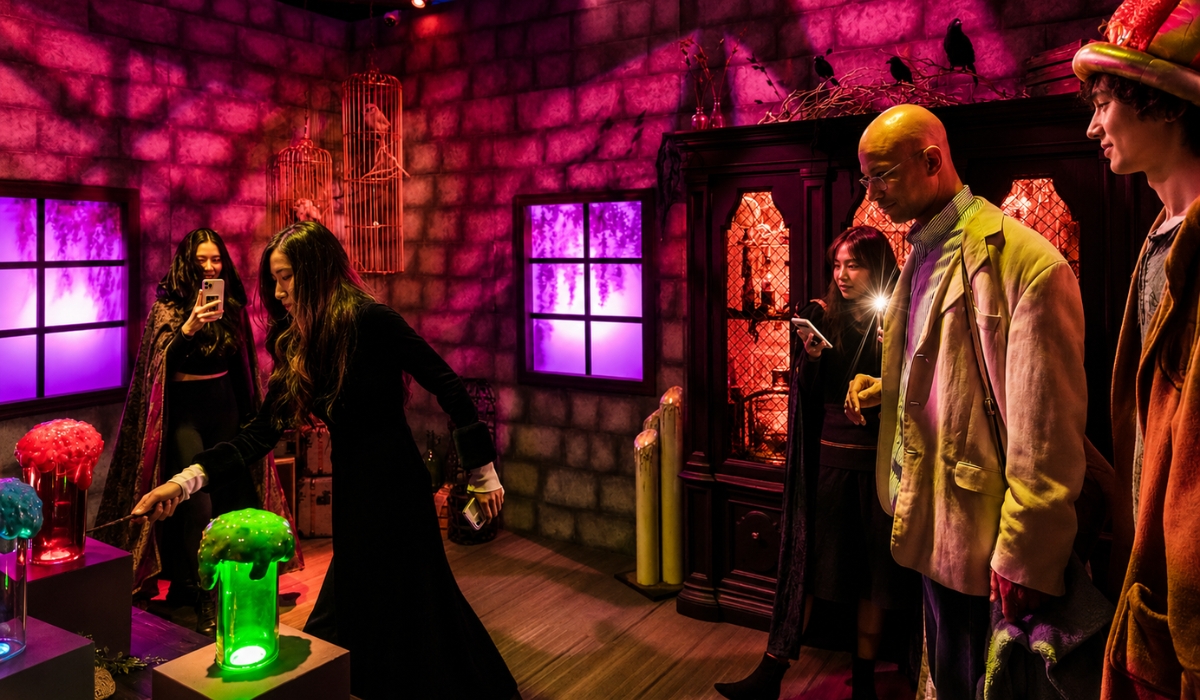
Wings and Wizards offers a compelling example through an interactive ticketed experience created at BC Place. Go2 Productions collaborated with SHINE Experiences, Innovation Lighting, and Spectra Event Group to develop an immersive walkthrough where groups journeyed through a castle and enchanted forest in search of a dragon egg. Each room represented a different chapter of the story, and participants needed to complete interactive tasks to advance in their quest.
The experience integrated motion tracking, proximity-based technology, lighting, projection, physical props, soundscapes, and interactive installations. Guests learned wand movements, completed colour-sequence spells, followed instructions, and triggered responses from the environment as they progressed.
Experience design connected all these systems. The narrative determined how guests moved from room to room, while audience flow established the sequence of interactions. Interactive technology allowed participants to engage with the story, and projection, lighting, sound, and scenic design created the immersive world around them.
Wings and Wizards illustrates how immersive technology can enhance a physical experience when the narrative, environment, and audience interaction are thoughtfully defined
Final Thoughts
Experiential design shapes how people encounter and interact with an environment. It combines disciplines such as spatial design, storytelling, sound, lighting, digital content, physical objects, and interactive technology to create a complete experience centred on the person within the space.
Its applications extend across retail, museums, exhibitions, ticketed attractions, themed environments, seasonal experiences, experiential marketing, and live events.
Go2 Productions works with agencies, brands, and event producers to create immersive experiences using interactive installations, projection mapping, custom content, 3D animation, and other creative technologies. Contact Go2 Productions to discuss how experiential design can shape your next event, brand activation, exhibition, or ticketed attraction.