
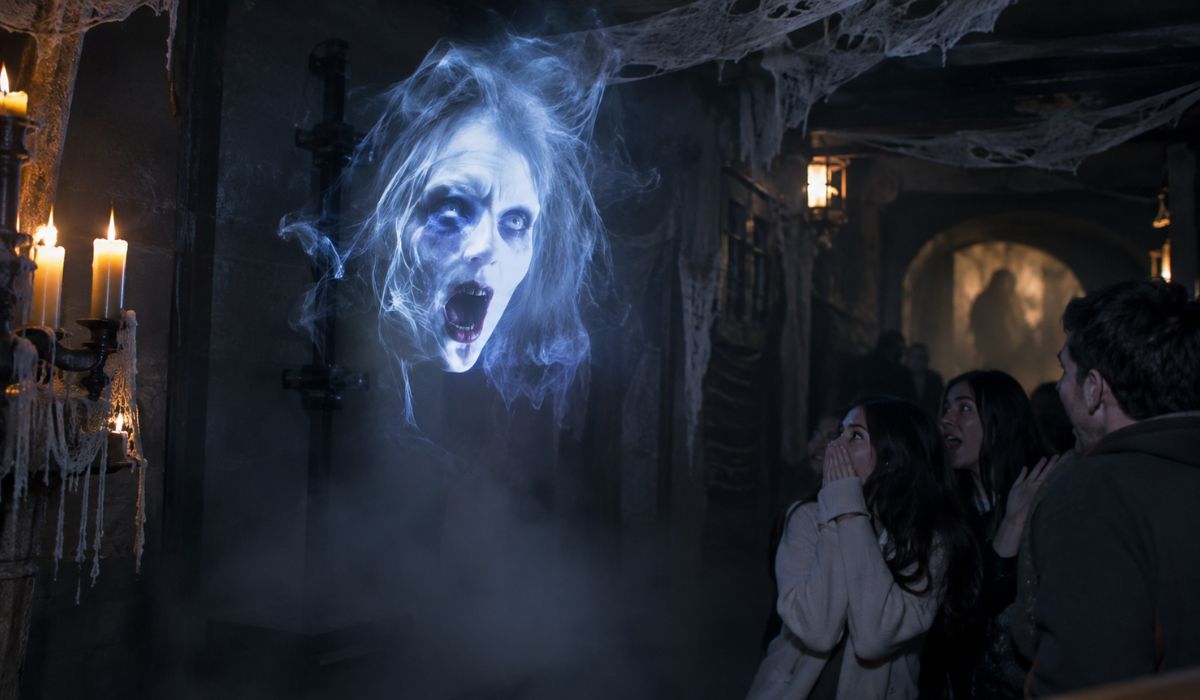
Halloween is a season that many people eagerly anticipate. For many, it is their favourite time of the year, largely due to the numerous events, experiences, and activities available to enjoy during this festive occasion. From the perspective of entrepreneurs and business owners, Halloween offers a fantastic opportunity to boost profits by providing engaging experiences for people. This can range from large-scale events to simple immersive decorations that can attract customers to your store or business.
If you arrived at this article, you’re probably already planning a Halloween event and wondering how to create a visual effect that simulates a ghost appearing in the middle of a dark hallway, floating somewhere in your venue, or suddenly materializing behind a window. Well, in this article, we will show you a few ways to use technology to create holograms and ghost effects for Halloween events.
1. Create Floating Ghosts With HYPERVSN Technology
The first way to create ghost effects at your Halloween event is by using HYPERVSN technology, which is a holographic display that uses high-speed LED rotors to create 3D visuals that appear to float in mid-air. The blades rotate faster than the human eye can clearly distinguish them, so people mainly perceive the animated content instead of the physical mechanism producing it.
HYPERVSN systems can operate as individual displays for smaller holographic visuals for restaurants, bars, retail shops, and other commercial spaces or be synchronized into larger configurations for large-scale activations, events, music festivals, and more.
For a Halloween event, this technology could be installed inside a haunted hallway, themed room, retail window, entrance area, or another controlled part of the visitor journey. Imagine guests entering a haunted house attraction where a floating head suddenly appears inside a dark doorway, speaks for several seconds, and disappears before the group moves into the next room. A store, hotel, or restaurant could use the same technology to display a floating skull, pumpkin, ghost, or branded Halloween character in its front window to catch the attention of people walking past.
For HYPERVSN, the content needs to be created specifically for the floating effect. Large dark areas around the animation keep attention on the character, while visual details such as glowing eyes, smoke, illuminated edges, or particles can make the ghost easier to see. Because HYPERVSN produces its imagery directly from LEDs, it also gives producers a compact solution for spaces where installing projectors, mesh, and long projection distances would be complicated.
Now, if your Halloween concept requires a ghost that is several metres tall or needs to appear across a much larger physical space, projection opens a different creative direction. Let’s dive into it.
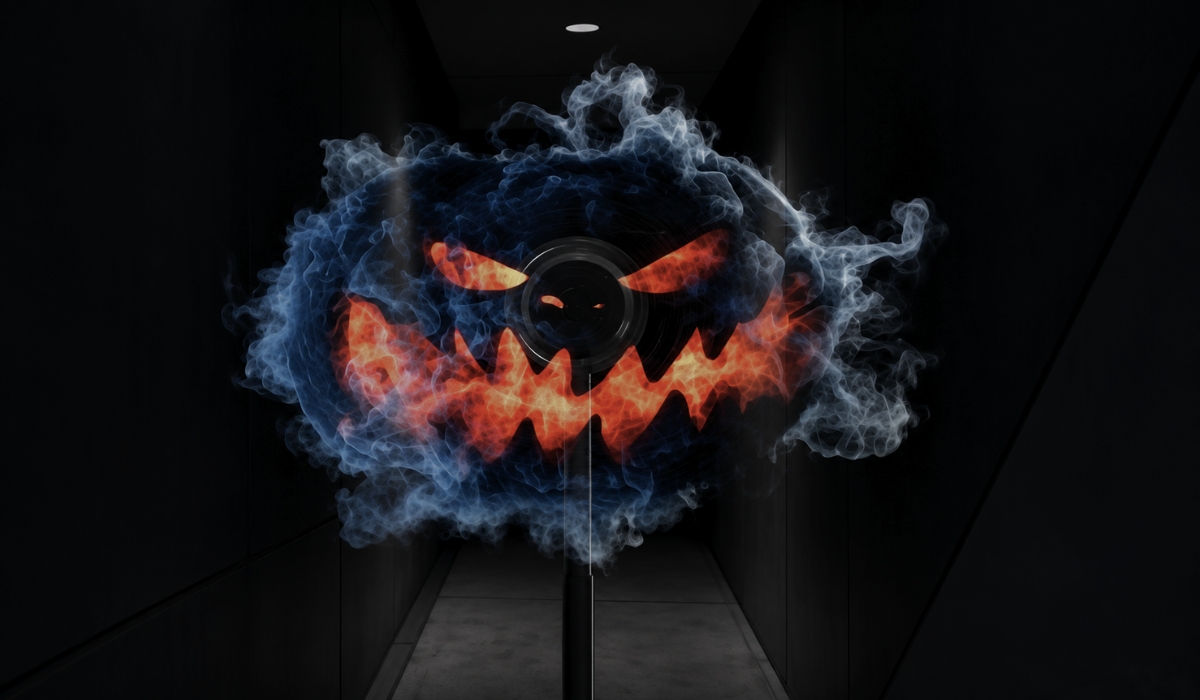
HYPERVSN – Halloween Hologram Displaying a Pumpkin Ghost
2. Create Large Ghosts With Projection and A Transparent Mesh
The second technique combines projection with a transparent mesh or holographic scrim. In this technique, you can create the visual illusion of having massive spirits, ghosts and holograms thanks to he mesh, which becomes the projection surface, while custom 3D animation creates the character that guests see floating within the environment. This technique needs to be applied where lighting can be controlled because under dark conditions, the mesh is difficult to see and identify, leaving the illuminated ghost or creature as the main visual element and giving the illusion of floating in the middle of thin air.
In this setup, projection functions by sending light onto a surface, so excessive ambient light can reveal the mesh and reduce the contrast of the character. A dark forest, haunted room, theatre, thematic corporate event, or nighttime outdoor attraction gives the production team much greater control over the illusion. Black areas inside the content receive very little projected light, which lets the surrounding environment remain visible while the brighter parts of the ghost appear on the mesh.
The scale is where this technique is particularly interesting for Halloween events. For example, a producer could create a giant spirit floating in the background of a venue, a ghost moving across the trees, or a creature appearing above guests as they enter a haunted attraction. Custom 3D animation also gives the character movements that would be difficult to reproduce with a physical prop. The ghost could slowly materialize from particles, transform into another creature, disappear into smoke, and return somewhere else on the projection surface.
At Go2 Productions, we used the same projection principle for Aurora Spirits, installing an 80-foot-wide by 18-foot-high transparent scrim in front of an LED wall. The mesh carried holographic projections of the Aurora Borealis and large animal spirits connected to Squamish Nation legends, while performers occupied the physical space between the transparent projection layer and the LED backdrop.
For Halloween producers, this combination of transparent projection, darkness, physical scenery, and animated characters creates opportunities to place digital ghosts directly inside the environment guests are exploring.
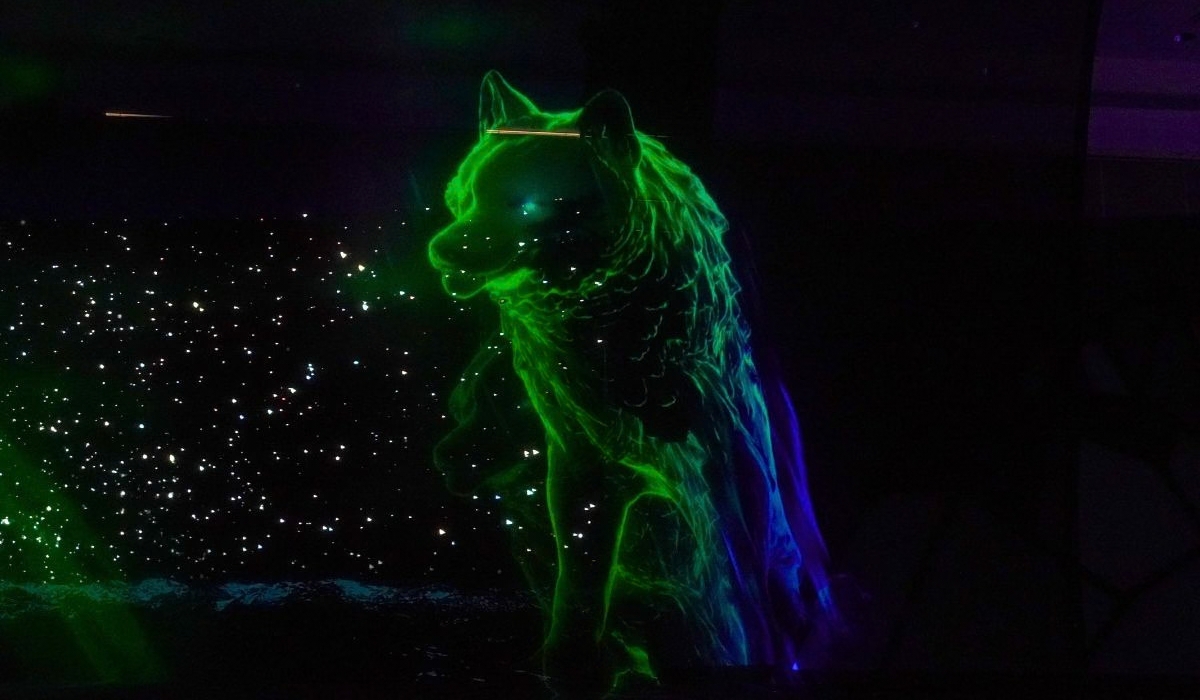
Aurora Spirits – Projection on Mesh Holographic Animation
3. Create Ghost Effects With Transparent LED Displays
Our last option to achieve ghost effects is thanks to advancements in LED technology, and we refer to the use of transparent LED displays with custom animated content. Similar to our last technique, instead of projecting an image onto a mesh, the transparent LED film produces the image directly through LEDs while still allowing the audience to see part of the physical environment behind it. This creates another way to layer digital ghosts over real scenery.
For example, imagine a haunted house experience where visitors can clearly see physical equipment, tables, and props through a transparent screen. As they approach, a ghost appears in front of those objects and moves through the scene before disappearing again. A Halloween-themed hotel could place a transparent LED display inside a window, giving guests the impression that a ghost is standing inside the room while the furniture and scenic decoration remain visible behind it.
Transparent LED can also give producers more control in areas where the environment cannot be completely dark. Projection loses visible contrast as ambient light increases, while LED displays generate their own light directly from the screen. The amount of transparency and brightness depends on the specific product. For reference, LG currently offers transparent LED film with approximately 60% transmittance and 1,000 nits of typical brightness, demonstrating how digital content and visible physical scenery can occupy the same viewing area.
Lastly, in this technique, the animation needs to be designed around the transparent canvas. Covering the entire display with bright graphics will make the technology more noticeable, while isolating the ghost, creature, smoke, or visual effect keeps the physical environment visible around it. The producer can then use that relationship between digital content and real scenery to make the apparition feel connected to the Halloween set.
Now that we have covered three different ways to create holographic ghosts, let’s look at how one of these techniques was applied in a real environment.
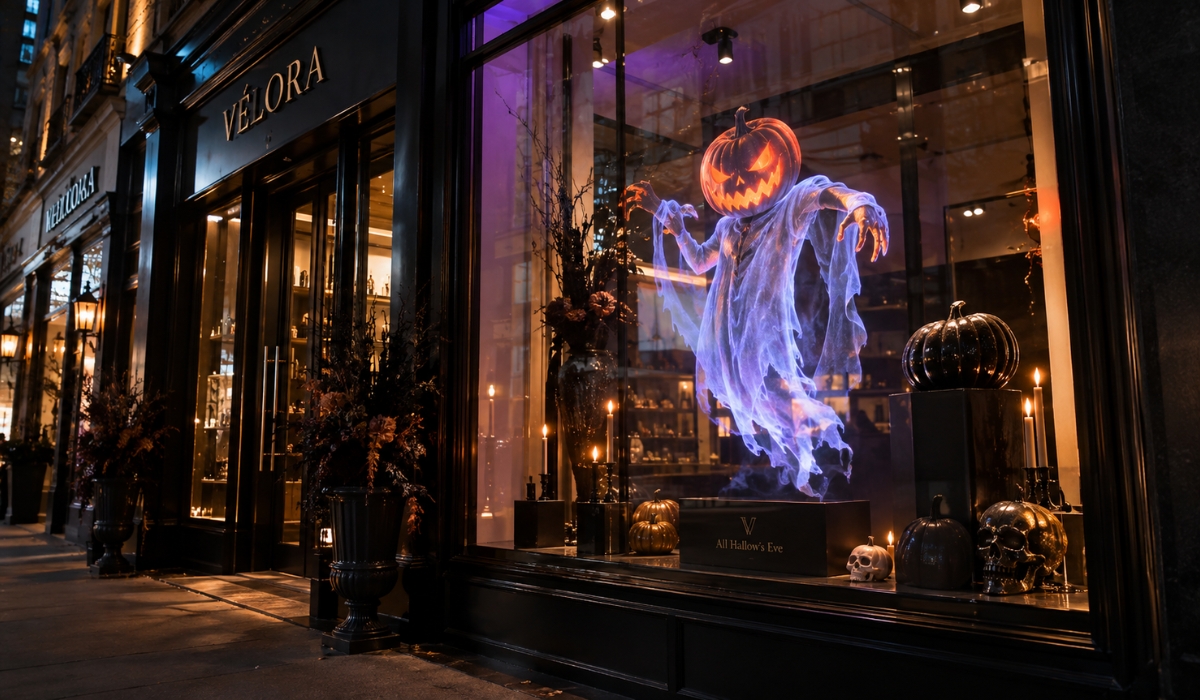
LED Transparent Display Halloween Content Concept Art
Wildlight: Creating Massive Spirits Inside a Real Forest
For the 2025 edition of Canyon Lights at Capilano Suspension Bridge, Go2 Productions created an installation called Wildlight, where massive spirits of animals (very close to ghosts) from the Pacific Northwest appeared inside the darkness of the forest. The original creative direction focused on the relationship between people and wildlife, but the technical setup demonstrates the same principles event producers can use to create ghost effects for Halloween.
The installation used custom 3D animal animations projected onto transparent black mesh suspended between real trees. At night, the mesh visually disappeared into the forest while the illuminated animals remained visible, creating the illusion that giant spirits were occupying the space between the trees. In this example, the natural environment was part of the effect because visitors could still see the forest surrounding the animated characters.
The projector and technical equipment also needed to stay outside the audience’s attention. Once guests stopped noticing the projection surface and equipment, their focus moved toward the spirit itself. This principle is especially important for Halloween attractions because part of the effect comes from leaving the audience uncertain about how the illusion is being created.
The same setup could take a much darker creative direction for a Halloween event. Instead of animal spirits, a forest could contain spectral figures connected to a fictional story, shadow creatures moving between trees, witches appearing above the pathway, or ghosts that emerge only as visitors reach a specific part of the attraction. Custom animation controls when the apparition appears, what it does, how long guests see it, and how it disappears before they continue through the experience.
Choosing the Right Hologram Technology for Your Halloween Event
As we have seen, all three techniques create floating digital characters, but they produce very different visual results. HYPERVSN is suitable for defined areas where the producer wants a compact floating character or object. Projection onto transparent mesh supports much larger apparitions and gives producers significant creative freedom in dark environments. Transparent LED displays layer digital characters over physical scenery and can operate in spaces where controlling ambient light is more difficult.
By analyzing your event goals, available space, audience viewing distance, lighting conditions, installation points, guest movement, and the size of the character, you can determine which technology makes sense for the attraction.
After selecting the right technology or combination of all of them, the content becomes the next major consideration. Character movement, contrast, scale, timing, colour, sound, and the way the ghost enters and disappears from the scene all contribute to the final illusion. The digital asset technical specs will change depending on the technology and the physical space where guests will encounter it.
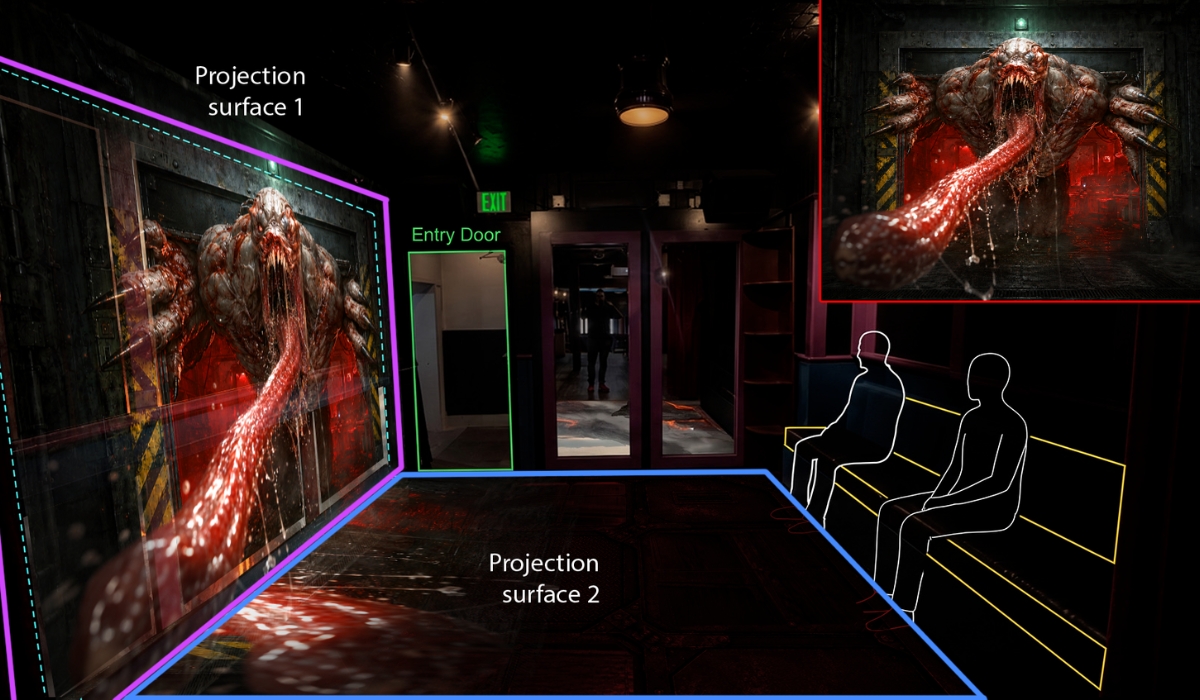
Sketch – Planning a Holographic Halloween Experience
Final Thoughts
So, how can you create holograms and ghost effects for Halloween events?
Well, in this article we discussed how HYPERVSN technology, projection onto transparent mesh, and transparent LED displays all provide different ways to place digital characters inside physical environments. Each setup has its own technical challenges to make the visual effect outstanding. The best way to achieve great results is to contact professionals as creative partners.
Contact Go2 Productions to discuss how custom 3D animation, holographic displays, and projection technology could be incorporated into your next Halloween event or immersive attraction.